

How Blockchain Works (Consensus, Smart Contracts & Network Mechanics)
By MUMBCC Research Team
A block is a basic unit in a blockchain that stores validated transactions and links to previous blocks, creating an unchangeable record.
How does blockchain work (step by step) (how does money / crypto move)
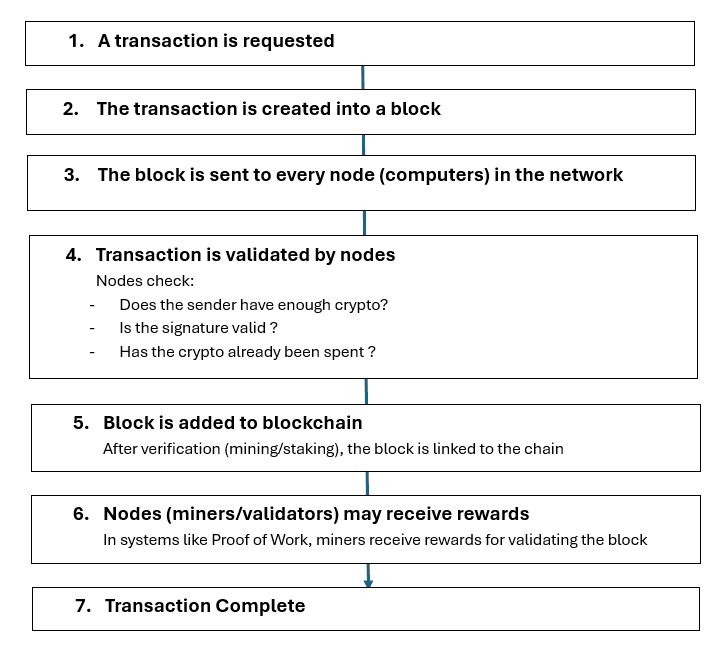
Source: https://www.geeksforgeeks.org/ethical-hacking/how-does-the-blockchain-work/
Blocks and hashing (how blocks are link) (first introduce what is block what is hash and how does it work and what is it characteristics)
What is Block?
A block is a basic unit in a blockchain that stores validated transactions and links to previous blocks, creating an unchangeable record.
Source: https://www.investopedia.com/terms/b/block-bitcoin-block.asp
Each block usually contains:
A list of transactions
A timestamp
A reference to the previous block (called a hash)
Its own unique hash
A nonce (used in mining)
Other metadata (depending on the blockchain)
Source: https://crypture.org/what-is-a-block-in-a-blockchain-a-complete-beginners-guide/
What is a Hash ?
A hash is a function that converts any input (letters & numbers) into a fixed-length output.
It is created using a hashing algorithm (e.g., Secure Hashing Algorithm 256 (SHA-256)).
Source: https://www.investopedia.com/terms/h/hash.asp
How do block hashes work
Input Data : The block contains data
Hash Function : The data is passed through a special formula (hash function)
Hash Output : The result is a fixed-length code called a hash
Source: https://www.geeksforgeeks.org/computer-networks/how-block-hashes-work-in-blockchain/
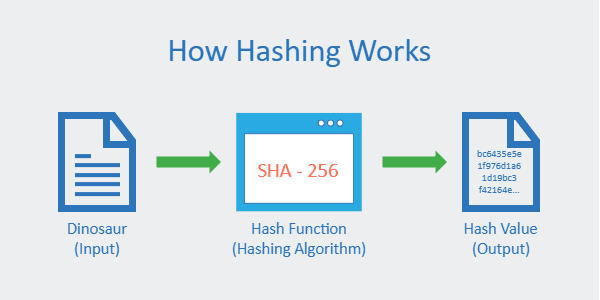
Source: https://codesigningstore.com/what-is-hashing-algorithm-how-it-works
Key Characteristics of Hashing
Characteristics
Deterministic
Same input → same hash every time
Unique (almost impossible to duplicate)
Different input → completely different hash
Fixed length
No matter how big the data is → hash length is always the same
One-way (irreversible)
You cannot get the original data from the hash
Sensitive to change
Even a tiny change → totally different hash
Source: https://kba.ai/hash-function-the-heart-of-blockchain/
How blocks are linked
Each block contains the hash of the previous block.
This creates a chain of blocks → blockchain
Source: https://www.geeksforgeeks.org/computer-networks/blockchain-chaining-blocks/
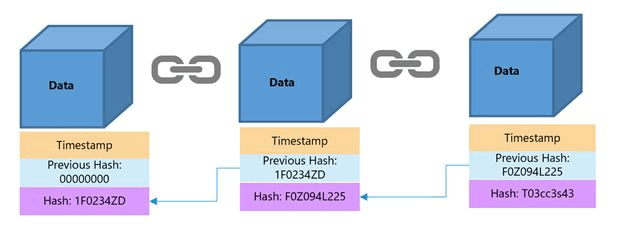
Source: https://www.c-sharpcorner.com/article/what-is-blockchain/
Node and the Peer - to - peer network (explain who runs the blockchain)
What is a Node?
A node is a device (typically a computer) that maintains a copy of the blockchain and assists in validating and relaying transactions.
Each node is responsible for tasks such as:
- Verifying transactions
- Sharing blocks and information with other nodes
- Storing blockchain history
- Enforcing consensus rules
Source: https://crypture.org/what-is-a-node-in-a-blockchain-network/
What is a Peer-to-Peer (P2P) Network?
A peer-to-peer network refers to a group of computers or devices that share and access resources independently, without centralized control.
Source: https://www.computernetworkingnotes.com/networking-tutorials/peer-to-peer-networks-explained.html
Who runs the blockchain
Blockchain is run by a decentralized peer-to-peer network of nodes, where computers connect directly with each other to verify transactions and maintain a shared record without a central authority.
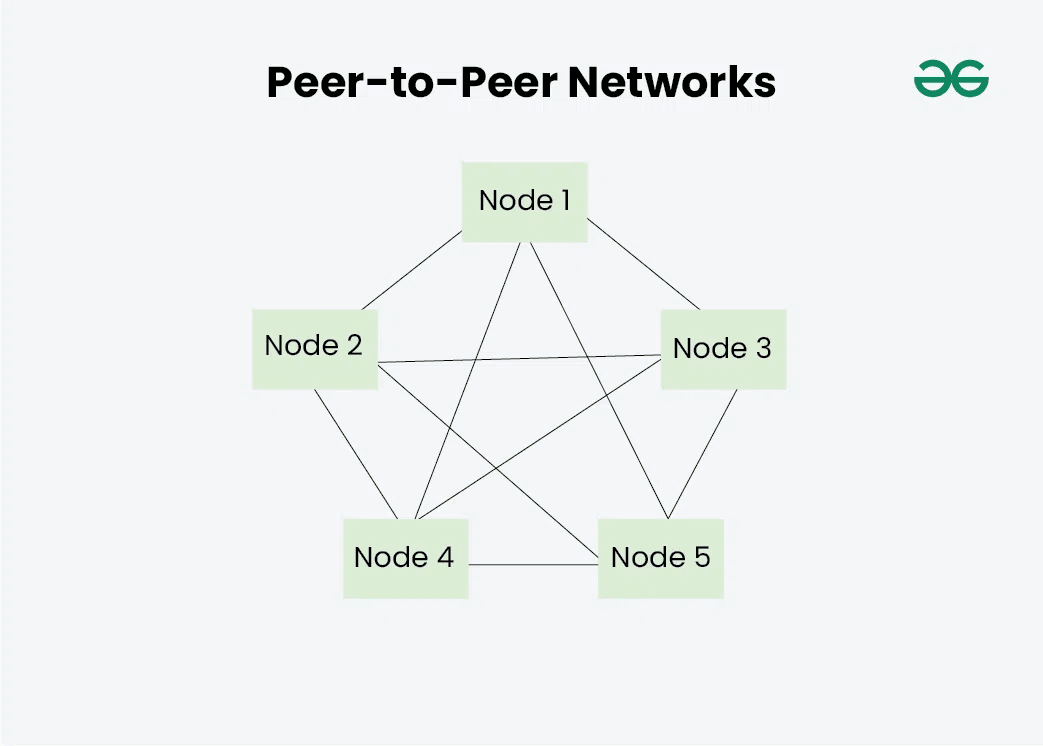
Source: https://www.geeksforgeeks.org/system-design/hierarchically-organized-peer-to-peer-networks/
Consensus Mechanisms (How the network agrees) (Proof of work, Proof of stake)
Consensus Mechanisms: How the network agrees
Blockchain is a group project where everyone must agree before a block is added, no bank or central boss needed. This agreement is called consensus.
1. Proof of Work (PoW)
Computers solve hard puzzles to approve transactions
First to solve → adds block + gets crypto reward
Keeps blockchain secure, but uses a lot of energy
2. Proof of Stake (PoS)
Validators lock their coins as “stakes”
More coins = higher chance to add block
Uses way less energy than PoW
Source: https://www.blockchain-council.org/blockchain/consensus-mechanisms-in-blockchain-2
Mining and block creation
Mining
verifying transactions & creating a new block
First miner to finish the “puzzle” adds the block to the chain
Reward = crypto coins for miners/validators
Source: https://www.blockchain.com/learning-portal/lessons/bitcoin-mining-explained
How Block Creation Works
Users make transactions
Transactions are collected into a block
Miners compete to solve a complex problem
First miner to solve it → verifies the block
Block is added to the blockchain
Source: https://bitcoin.org/en/how-it-works
Smart contracts (Automated Agreement)
A smart contract is an automatic digital agreement stored on the blockchain. It runs by itself when certain conditions are met, without needing a middleman like a bank or lawyer.Example platform: Ethereum
Source: https://www.ibm.com/think/topics/smart-contracts
How it works:
First, both parties agree on the conditions.Then, the rules are written into code and stored on the blockchain.When the condition is met, the contract automatically executes.
Example:
NFT MarketplacesPlatform: OpenSea
How it works:
You pay for NFT
Smart contract transfers ownership to you
Creator can even get royalties automatically
Advantages:
Fast, secure, transparent, and reduce the need for intermediaries, which can lower costs